
Why Portland home sales are falling through, and where it isn't happening

You are going to read a lot about this number over the next few weeks. Here is ours.
The short version
The 17.2% is real. In close-in Northeast and inner Southeast Portland it barely applies: a well-kept detached house still sells in a week or two, at or over asking. In outer East Portland, parts of North Portland, the Southwest hills and the condo towers, buyers have choice, and an old roof or an unscoped sewer line is the kind of thing they walk over. Find out what your inspector would find before the buyer's does.
The number, and what it hides
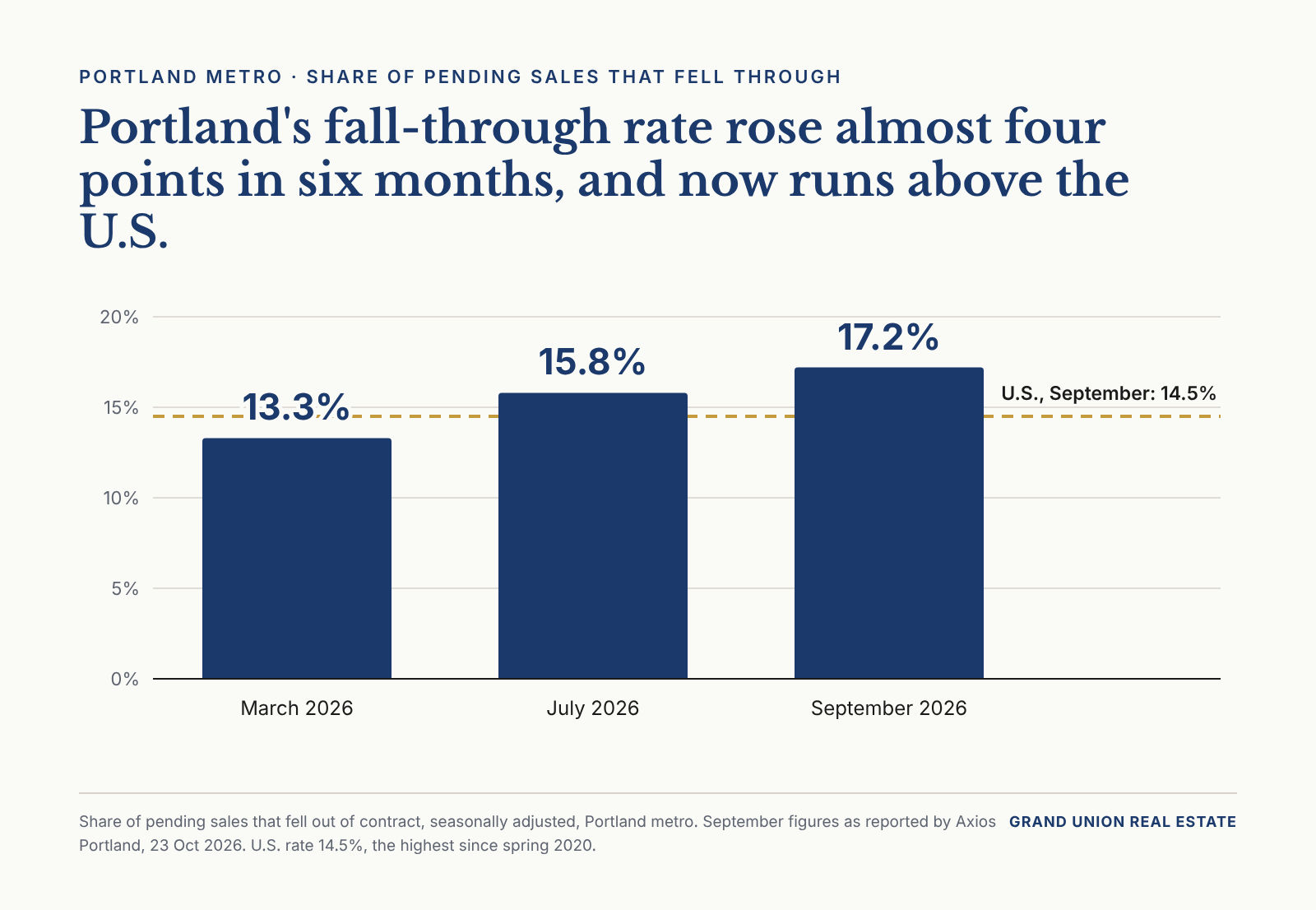
17.2% of Portland-metro home sales that went pending in September fell through, as Axios Portland reported on October 23. The national figure was 14.5%, the highest since the spring of 2020. Portland was at 13.3% in March and 15.8% in July. The direction is not in question.
But a metro-wide average hides the part that matters if you own a house here. In the same month that one in six deals came apart, more than a third of Portland homes sold for over asking. Both things are true at once, and which one applies to you depends mostly on where your house is and what an inspector will find in it. (If you want the neighborhood-by-neighborhood sale prices behind all this, they're in our Portland home prices by neighborhood guide, updated monthly.)
Same city, same month, two markets
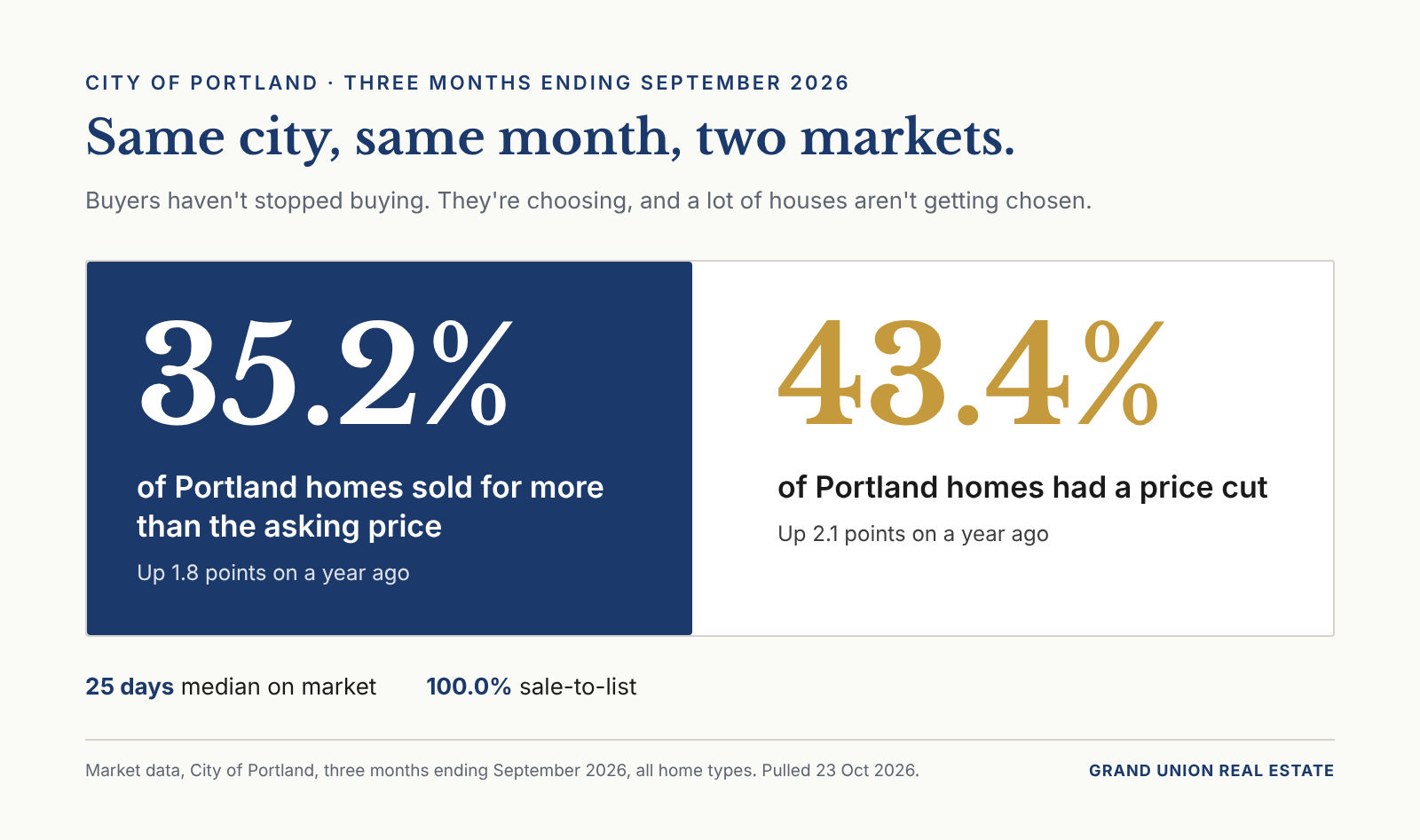
In the city of Portland, over the three months ending in September:
35.2% of homes sold above list price
43.4% of homes had a price cut
Median 25 days on market, and a sale-to-list ratio of exactly 100.0%
That is not a market that has stopped. Buyers are buying. They are choosing, and a lot of houses are not getting chosen. Most of the ones that fall through come back as “back on market”, which is the status buyers learn to read as a warning.
Why buyers are walking away
The payment. A new Portland buyer pays about $4,360 a month for mortgage, insurance and taxes, against about $1,800 for the typical renter (Zillow's August figures, via Axios Portland). The 30-year fixed rate was 7.32% in Freddie Mac's October 22 survey, against 6.19% a year ago. A buyer who stretched to get to the closing table has nothing left over for a surprise. Our first-time buyer monthly budget breaks that payment down line by line.
The options. Pending sales in the Portland metro were down 11.9% from a year ago in September. Fewer buyers, more houses. More than half of Portland sales, 57.6% in the three months to May, already included a seller concession — closing costs, repair credits, a rate buydown — against 46% nationally. A buyer who loses this house has another one to look at on Saturday.
The inspection. This is where most deals actually die. In a national brokerage's survey of its own agents, reported by Fortune last year, 70% named inspection and repair issues as a top reason buyers cancel; financing was a distant second at 28%. Closer to home, Portland broker Dirk Hmura of The Agency told Axios he estimates 25% to 30% of sales come back on the market after inspection.
Put those three together and the logic is simple. The inspection is the first moment a buyer learns what the house will really cost them, and it arrives at the exact point in the deal where they can still leave with their earnest money.
Why Portland houses give inspectors more to find
About 35% of the city's housing was built before 1950 (Greater Portland Inc.). Old houses are a lot of why people love living here. They are also why Portland inspection reports run long. The same handful of findings come up again and again:
Sewer laterals. The line from the house to the street is the owner's responsibility all the way to the curb, and if a break isn't fixed within 30 days of notice the city can do the work and lien the property (City of Portland). Clay and cast-iron pipe plus a hundred years of street-tree roots is a common combination. What a sewer scope finds, and what it costs to fix.
Underground oil tanks. Sellers must disclose a known tank, and the owner is liable for a leak even if it predates them (Oregon DEQ). Some buyers and lenders won't proceed without state-standard decommissioning. Oil tanks, the law, and who pays at closing.
Radon. In several Northeast Portland ZIP codes, more than 40% of tested homes came in above the EPA's action level — 50.3% in 97213, 43.5% in 97218, 42.5% in 97211 (Oregon Health Authority, most recent ZIP table, 2023).
Roofs and old wiring. Knob-and-tube and end-of-life roofs are both things insurers ask about, which makes them the buyer's problem the moment they're in the report. If insurance is already on the buyer's mind, this is what they're checking.
None of these is unusual. What changed is that buyers now have the room to walk away from them.
Where it's still a seller's market
The neighborhood figures for the three months ending September tell a clear story. Detached houses in close-in Northeast and inner Southeast Portland are still selling fast and at or over asking.
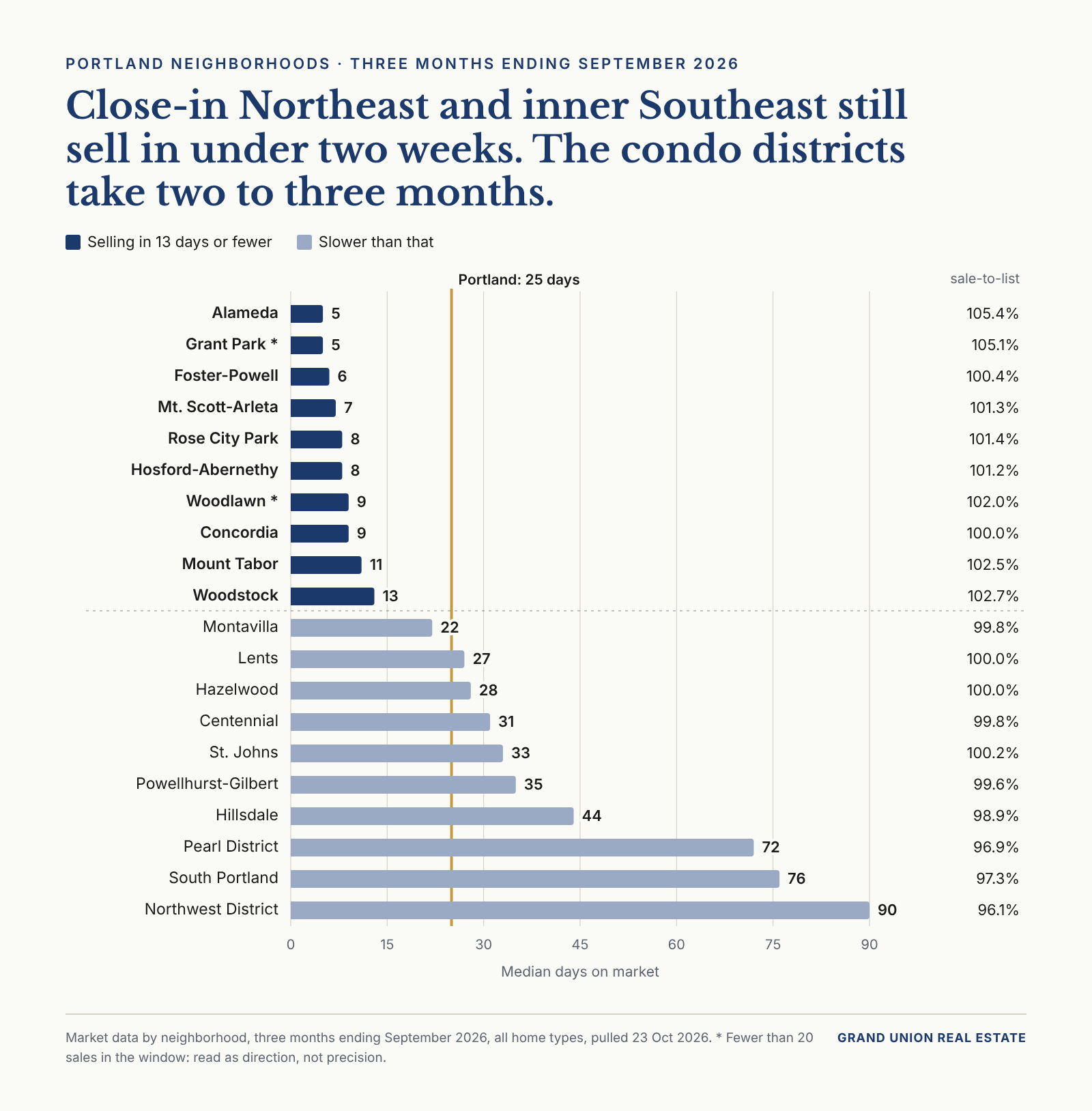
Neighborhood | Median days on market | Sale-to-list | Sold over list |
|---|---|---|---|
Alameda | 5 | 105.4% | 70.7% |
Grant Park † | 5 | 105.1% | 77.6% |
6 | 100.4% | 34.7% | |
7 | 101.3% | 27.9% | |
8 | 101.4% | 45.0% | |
Hosford-Abernethy | 8 | 101.2% | 36.3% |
Woodlawn † | 9 | 102.0% | 52.5% |
9 | 100.0% | 47.1% | |
Mount Tabor | 11 | 102.5% | 39.3% |
Woodstock | 13 | 102.7% | 51.0% |
Portland, citywide | 25 | 100.0% | 35.2% |
† Fewer than 20 sales in the window; read as direction, not precision. Market data, three months ending September 2026, all home types.
What these places share is not price. Foster-Powell's median is about $430,000 and Alameda's is close to $980,000. What they share is close-in location and mostly detached houses. When a well-kept one lists, buyers move fast, and an inspection finding becomes a negotiation instead of an exit.
One caution even here: fast is not the same as up. Beaumont-Wilshire sold in a median 13 days at 102% of list, and its median price was still down 10.6% from a year ago. Buyers will move quickly on the right house at the right price. They are not paying last year's price for it.
Selling in one of these neighborhoods? Our seller briefs go street by street: Rose City Park / Beaumont · Alberta / Concordia · Irvington · Laurelhurst · Kerns · Ladd's Addition. Or start with the region: Northeast Portland · Southeast Portland · Inner East Side.
Where buyers have the leverage
Outer East Portland, parts of North Portland, the Southwest hills and the downtown condo districts look very different.
Neighborhood | Median days on market | Sale-to-list | Homes with a price cut |
|---|---|---|---|
27 | 100.0% | 60.9% | |
28 | 100.0% | 56.3% | |
31 | 99.8% | 40.2% | |
33 | 100.2% | 43.4% | |
35 | 99.6% | 38.2% | |
Hillsdale | 44 | 98.9% | 63.1% |
72 | 96.9% | 45.6% | |
South Portland | 76 | 97.3% | 48.8% |
Northwest District | 90 | 96.1% | 48.4% |
Market data, three months ending September 2026, all home types.
Price is not the protection here either. Hillsdale's median is about $759,000, and it had the highest share of price cuts of any neighborhood we pulled. The condo districts are the softest market in the city: Multnomah County condos are averaging 81 days on market, and in the first half of the year more than half closed below list.
Nobody publishes fall-through rates by neighborhood, so we can't tell you Lents runs at 25% and Alameda at 5%. What the figures do show is where buyers have the most choice — and a buyer with choice is the buyer who walks after a bad inspection.
If you're buying in these neighborhoods, that is good news. You have room to inspect properly, ask for repairs and be told yes. Our briefs for Lents, Hazelwood, Powellhurst-Gilbert, Centennial, Brentwood-Darlington and Cully have the county sale figures for each, and the regional guides cover the rest: East Metro · North Portland · Northwest and Downtown · Southwest.
If you're selling: take the reasons to walk off the table
The sellers doing best right now are the ones whose house is easiest and least risky to buy. In this market the risk you remove before listing is worth more than the risk you negotiate after.
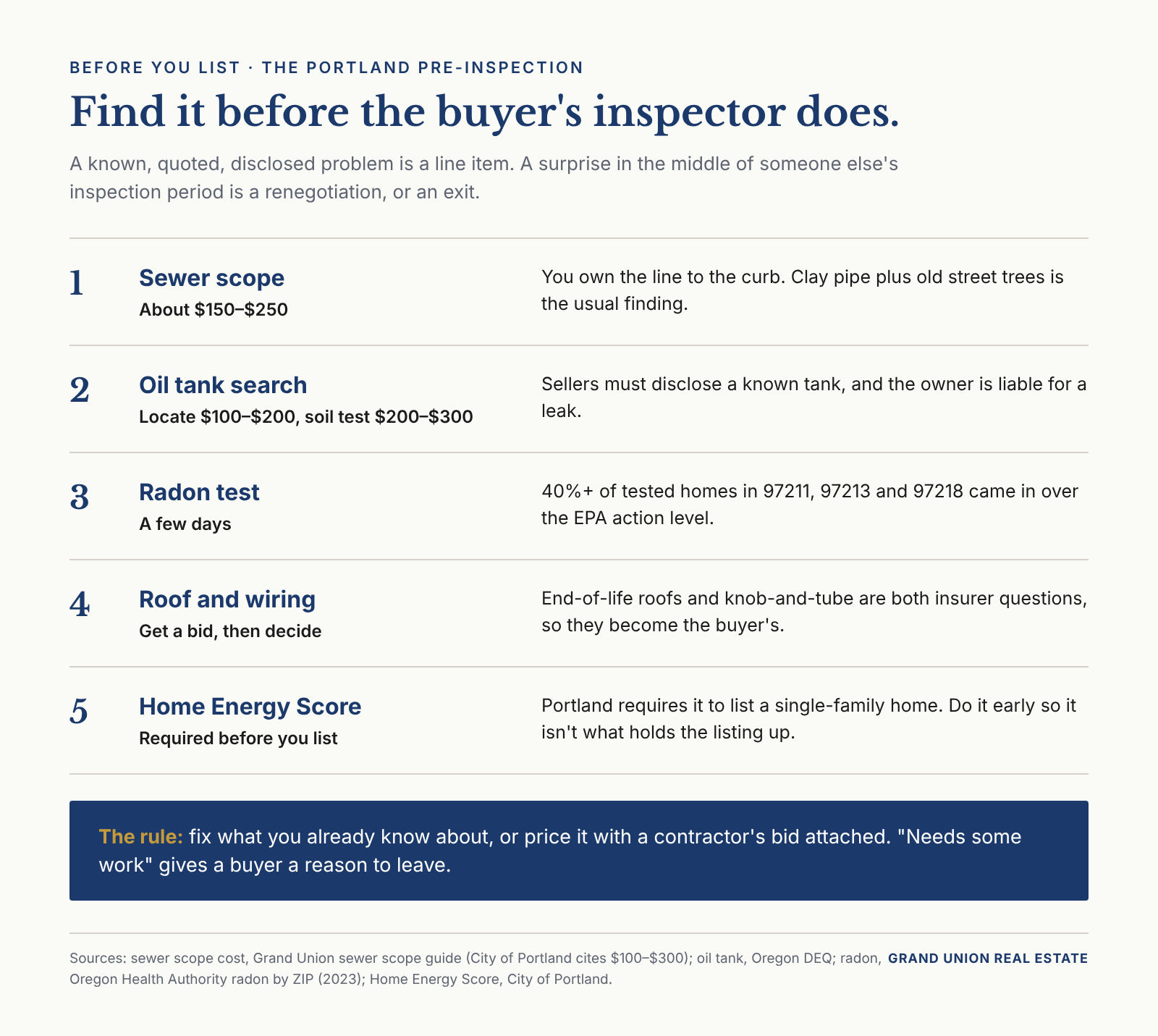
Get your own inspection first. Find out on your timeline instead of in the middle of a buyer's, when the news has the most leverage against you. A known, quoted, disclosed problem is a line item. A surprise is a renegotiation.
Run the Portland-specific checks. A sewer scope runs about $150 to $250. A DEQ-standard oil tank search runs $100 to $200 and a soil test $200 to $300. A radon test is cheap and takes a few days. And you'll need a Home Energy Score before you list in Portland anyway.
Fix the thing you already know about. If the roof has been nagging you, replace it. If the sewer line has been backing up, scope it and fix it. Nationally, Zillow finds move-in-ready homes sell for about 2.9% more than expected and fixer-uppers for about 14% less. A buyer stretched to $4,000 a month pays a premium for not having a project.
If you won't fix it, price it. A disclosed issue with a contractor's bid attached gives a buyer a number to decide on. "Needs some work" gives them a reason to leave. Disclose properly on the Oregon seller property disclosure statement, and know what the repair credit will do to your closing costs.
Price it right the first time. Hmura told Axios that several of his recent listings — staged, cleaned, painted and priced sensibly — drew three to eight offers. The ones that sit, by the same account, are the overpriced and the unprepared: longer waits, bigger cuts, and buyers asking for repair credits.
Thinking about selling and want to know which market your house is in? Start a conversation, or see how we sell homes.
Read next: Portland home prices by neighborhood · Sewer scope inspections · Underground oil tanks · Listing status changes
Compare neighborhoods: Portland home prices by neighborhood · Northeast Portland neighborhood guide
Sources: fall-through rates, Axios Portland, 23 Oct 2026, and the same seasonally adjusted series for March and July 2026. City and neighborhood figures: market data, three months ending September 2026, all home types, pulled 23 Oct 2026; seller concessions, three months to May 2026. Freddie Mac Primary Mortgage Market Survey, 22 Oct 2026. Axios Portland, 11 Sep and 23 Sep 2026. Agent survey via Fortune, 13 Oct 2025. Zillow via RISMedia, 25 Mar 2026. Greater Portland Inc. community profile, Sep 2026. Oregon DEQ heating oil tanks; City of Portland sewer and drain lines; Oregon Health Authority radon by ZIP (2023). Multnomah County condo figures from RMLS, Oct 2026. Neighborhoods with fewer than 20 sales are marked.


Comments